Ryan Pitts: What We Carry Forward
More than fifteen years after the Battle of Wanat, Medal of Honor Recipient Ryan Pitts still measures the story not by the award he received, but by the men who made sure he lived to tell it.
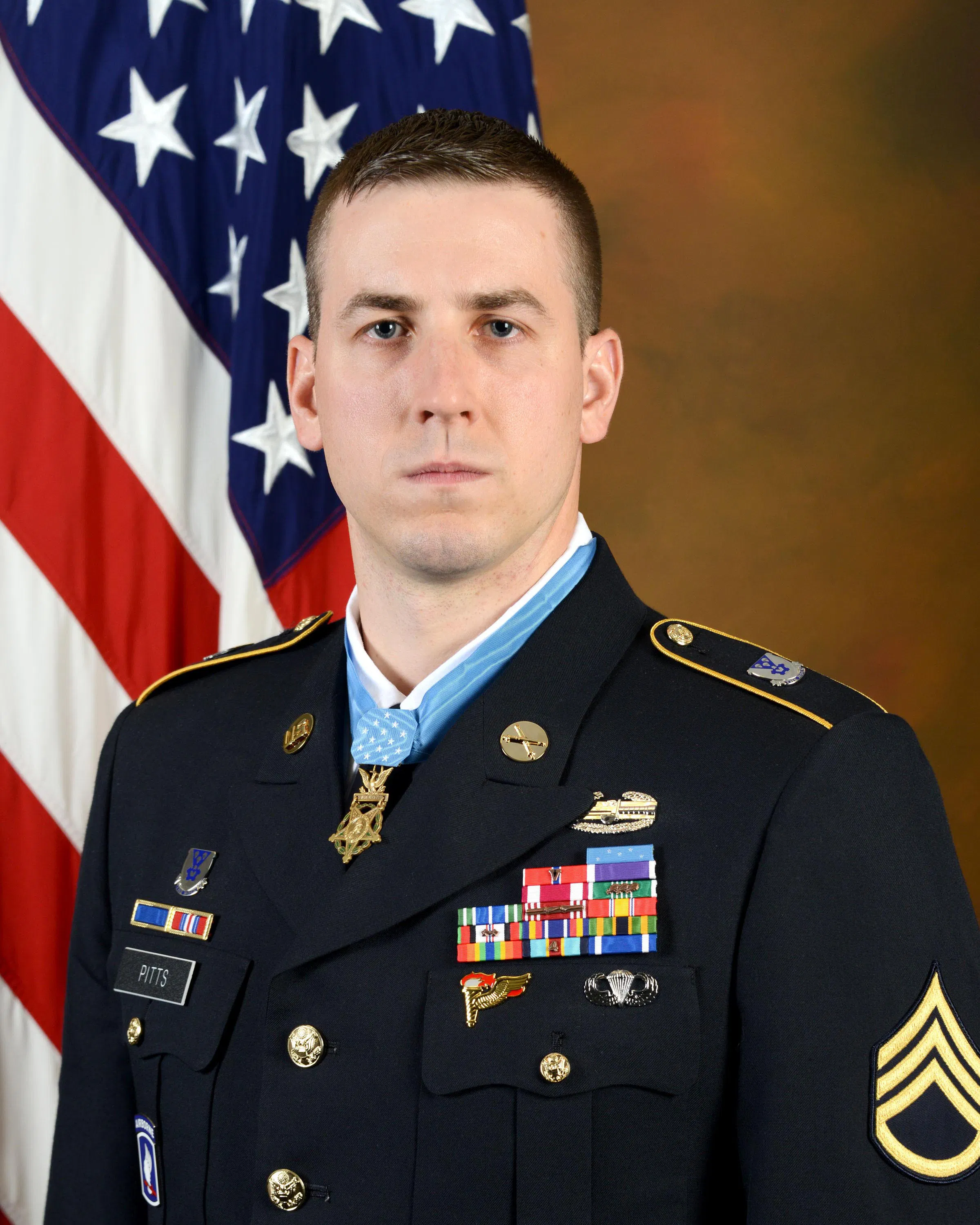
Medal of Honor Recipient Ryan Pitts still says their names every time he tells the story.
More than fifteen years after the Battle of Wanat in Afghanistan, Pitts rarely speaks publicly about the events that occurred on July 13, 2008, without pausing to remember the men who did not come home:
Specialist Sergio Abad.
Corporal Jonathan Ayers.
Corporal Jason Bogar.
First Lieutenant Jonathan Brostrom.
Sergeant Israel Garcia.
Corporal Jason Hovater.
Corporal Matthew Phillips.
Specialist Pruitt Rainey.
Corporal Gunnar Zwilling.
Over time, Pitts has come to describe the Medal not as something he earned, but something he carries on behalf of others.
“While the Medal of Honor is awarded to an individual, it has felt like anything but an individual achievement,” Pitts said during his Hall of Heroes address. “It is ours, not mine. I will wear it for everyone there that day, especially those we couldn’t bring home.”
That mindset has shaped nearly every interview and podcast he has participated in since receiving the Medal in 2014. When asked about courage, he talks about doing the right thing for others. When asked about leadership, he talks about teamwork.
And when conversations turn toward his own actions that day in Afghanistan, he redirects attention back toward the men who fought beside him.
“I Didn’t Know What I Wanted to Be”
Ryan Pitts spent much of his childhood moving throughout New England before his family eventually settled in New Hampshire, where long winters, dense woods, and rural isolation shaped the rhythm of daily life.
By the end of high school, Pitts still was not entirely sure what kind of life he wanted to build.
“I didn’t know what I wanted to be when I grew up,” Pitts recalled in an interview years later. “I knew my family would do everything they could to help me out with school, but I knew at that time I wasn’t going to be a great steward of their resources. So I decided to join the military.”
He enlisted in the Army in January 2003 at 17, needing his parents’ permission to sign the forms. At the time, the wars in Iraq and Afghanistan were already underway, though Pitts admitted later that he did not fully understand what that might mean.
“I kind of thought, hey, this is America. We’ll roll in. This will be over quick.”
Instead, the Army would reshape nearly every part of his adult life.
Testing Limits and Forging Bonds
Before leaving for basic training, Ryan Pitts had never been on an airplane. He had never traveled farther west than New York or farther south than Washington, D.C.
Pitts completed basic training at Fort Sill, Oklahoma, before heading to Fort Benning, Georgia, for airborne school and infantry training. Airborne training carried a mythology of its own — physically demanding, mentally exhausting, and built around the expectation that soldiers would willingly step out of an aircraft into uncertainty. Pitts later admitted he expected it to be much harder than it was.
“They do such a good job of training you,” he recalled years later. “By the time you get up there, that green light comes on, and you’re just thinking, ‘I gotta go out the door.’”
From Georgia, Pitts received orders to Italy, where he joined the 173rd Airborne Brigade Combat Team based in Vicenza as a Forward Observer—a specialized role responsible for coordinating and directing artillery and other supporting fire during combat operations.
Known as the “Sky Soldiers,” the 173rd traces its lineage back to World War II and became the Army’s only airborne brigade stationed in Europe after the Cold War. By the time Pitts arrived, the brigade had already earned a reputation for rapid deployment, aggressive operational tempo, and difficult combat assignments in both Iraq and Afghanistan.
The unit’s culture reflected that reputation. Soldiers trained hard, moved often, and were expected to adapt quickly. Every jump, drill, and cross-training exercise reinforced the understanding that success — and sometimes survival — rarely belonged to just one person.
By the time the platoon arrived in Afghanistan, Pitts and the soldiers around him had already spent months learning what it meant to rely on one another under pressure.
Years later, when Pitts spoke about courage, he rarely described it as fearlessness. Instead, he described it as a choice—to move toward danger, to step into the open, to protect one another, to keep doing your job.
“You’re going up against how many millions of years of evolution telling you to protect yourself,” Pitts explained in one interview. “Fight or flight isn’t a question — it’s flight.”
And yet, during combat, he watched men repeatedly move toward danger anyway.
“When you are there,” he said, “that’s not what is going through your head. It’s ‘I love these guys, and I don’t want to let them down.’”
That bond would be tested on the morning of July 13, 2008, when Taliban fighters launched a coordinated assault on a small American outpost near the village of Wanat in eastern Afghanistan.
The Battle of Wanat: “There’s No Timeout Here”
The Opening Barage
In the early morning hours of July 13, 2008, Taliban fighters launched a coordinated assault on Vehicle Patrol Base Kahler and Observation Post Topside near the village of Wanat in eastern Afghanistan.
Mortars and rocket-propelled grenades tore through the position as over 200 Taliban fighters attacked from multiple directions, targeting the small outpost with a level of organization and intensity unseen yet by American soldiers. Men were wounded almost immediately, including Pitts himself.
“I was shell-shocked for the first few minutes,” Pitts later recalled. “Then once I got the tourniquet on, and I was able to kind of start to get my bearings … it started to become clear, I can’t just sit there.”
What followed was a collective effort to hold the position—and keep one another alive.
Pitts later remembered Corporal Jonathan Ayers and Corporal Jason Bogar immediately returning fire during the opening barrage, despite the chaos erupting around them. Bogar moved repeatedly between returning fire and rendering aid to wounded soldiers—including a tourniquet on Pitts’s leg—regularly exposing himself to enemy fire to keep others alive as the position absorbed wave after wave of incoming rounds.
Ayers, a quiet soldier from Georgia who had driven trucks before joining the Army, carried a dependable steadiness that Pitts would remember long after the battle. Ayers took a round to his helmet that knocked him off his gun, and he got back on the gun and manned it until he was killed.
Pitts recalls, “As I look back on it—am I amazed at what he did? Yeah. Am I surprised that he dug deep like that and did that for us? No, that didn’t surprise me at all.”
Nearby, Corporal Matthew Phillips continued engaging enemy positions even as communication across the outpost began breaking down. Pitts later reflected that many of the soldiers had stopped waiting for detailed direction by that point, falling back instead on instinct, training, and the understanding that everyone had to contribute whatever they could to the defense.
Moving Toward the Fight
As casualties mounted, Specialist Pruitt Rainey moved through the position, helping redistribute ammunition and manage rates of fire while the outpost absorbed wave after wave of incoming fire. Friends back home in North Carolina would describe him as a “gentle giant,” someone younger kids naturally gravitated toward. At Wanat, Pitts remembered the steadiness he brought to the fight even as the situation around them grew increasingly chaotic.
At the center of much of that effort was First Lieutenant Jonathan Brostrom, who helped organize the defense as the attack intensified around Observation Post Topside. Pitts remembered Brostrom not simply as a platoon leader, but as someone deeply trusted by the men around him — tactically sharp, authentic, and focused far more on his soldiers than himself.
“He wasn’t trying to be anything other than himself,” Pitts later said. “He wasn’t making decisions based on his career. He was making decisions on what was best for us.”
As the situation at Pitts’s position became increasingly desperate, Brostrom began pulling together reinforcements, moving toward the fight himself and gathering volunteers along the way, including Jason Hovater, a twenty-six-year-old from Tennessee known for his humor, strong faith, and close ties to his family.
“Sweetest kid in the world — and so funny,” Pitts recalled. “But I remember that he would talk about being afraid to die — and that wasn’t something we talked about. We’re all beating our chests. Everybody’s fake-it-till-you-make-it. But he would talk about it.”
And yet, when Brostrom asked for volunteers to move into one of the battle’s most intense fighting, Hovater raised his hand—and went.
“We Haven’t Even Hit Ten Percent of the Iceberg”
Elsewhere across the battlefield, soldiers continued exposing themselves to enemy fire to protect the men beside them as the attack stretched on.
Specialist Sergio Abad, who was engaged and months away from becoming a father, remained part of the desperate effort to hold the position together despite mounting casualties around him. Sergeant Israel Garcia — remembered by family for his humor, easy smile, and love of soccer and horses — continued fighting alongside the rest of the platoon as communication and visibility deteriorated across the outpost.
Corporal Gunnar Zwilling, who had joined the paratroopers because he wanted challenge and intensity, stayed in the fight as wave after wave of incoming fire struck the position.
Years later, Pitts would still struggle to compress the scale of what happened at Wanat into a single story.
“We haven’t even hit ten percent of the iceberg,” he said in one interview. “There were so many other incredible things that people did that day.”
By the end of the battle, nine American soldiers had been killed and 26 others wounded, making Wanat one of the deadliest battles for U.S. forces in the Afghanistan War.
For Pitts, the years afterward would never separate the Medal he received from the men who made sure others survived alongside him.
A Medal Carried, Not Claimed
The Battle of Wanat lasted four hours, with multiple casualties within the first 30 minutes.
Six years later, on July 21, 2014, President Barack Obama awarded Pitts the Medal of Honor for his actions during the battle. The ceremony brought together surviving soldiers, Gold Star families, medevac crews, and the Apache pilots who helped bring others home that day.
For Pitts, that gathering mattered more than the recognition itself.
“It was awesome to be able to have everybody together,” he said later, “and be able to share in the fact that this is theirs just as much as it is mine.”
Even now, Pitts consistently describes himself less as the owner of the Medal than its caretaker.
“The Medal represents our sacrifices,” he said, “and those of every servicemember, and will forever serve as a memorial to the fallen.”
During his Hall of Heroes remarks, Pitts spoke directly to the families of the men killed at Wanat.
“To the families and loved ones of Sergio Abad, Jonathan Ayers, Jason Bogar, Jonathan Brostrom, Israel Garcia, Jason Hovater, Matthew Phillips, Pruitt Rainey, and Gunnar Zwilling: I’ve thought about them and their sacrifices every day. I will for the rest of my life — and I’m not alone. You raised, molded, and loved incredible men.”
“I miss them dearly,” he continued, “and it is awe-inspiring that such men lived.”
The Hardness That Came Later
Pitts spent roughly a year recovering from his injuries at Walter Reed before eventually transitioning into civilian life and enrolling in college to study mechanical engineering. For a while, he believed he had adjusted relatively well.
“Things didn’t really catch up with me until about ten years later,” he admitted on a recent podcast.
Pitts speaks openly about PTSD, hyper-alertness, and depression, describing them as “all very natural reactions to some very unnatural circumstances.”
“Sometimes I was able to overcome the obstacles on my own. Sometimes I wasn’t,” he said. “And that’s when you just have to pick up the phone and call somebody.”
For Pitts, conversations around mental health are not separate from the lessons soldiers learn in combat. “We don’t do things on our own — we don’t do anything on our own in the military,” he explained. “So it’s okay to ask for help.”
He has also spoken candidly about the isolation many veterans feel after returning home.
“I remember being in Afghanistan — 21, 22 years old — thinking that if I can get out and make $50,000 a year in an air-conditioned cubicle, life is gravy,” Pitts recalled. “And I got out, and I realized that life isn’t any easier as a civilian — it’s just a different type of hard.”
Still, Pitts keeps returning to the same idea that has shaped how he speaks about Wanat from the very beginning: it is about what people are willing to do for one another when everything is on the line.
“Everything that I did was because of the space given to me by the blood, sweat, and lives of the guys I was with and the many people who taught me,” he said. “The Medal represents sacrifice and the ideal of what we aspire to be in those moments.”
THEIR STORIES. OUR HISTORY.
Ryan Pitts continues to tell the story of Wanat through the men who trained and fought beside one another under impossible conditions. Not just moments of battlefield heroism, but the very human stories surrounding them: the relationships forged over time, the responsibilities people carry for one another, and the ordinary individuals capable of extraordinary sacrifice in service of others.
As America approaches its 250th anniversary, stories like these remain part of the living character of our nation — carried forward by those committed to remembering them.