Audie Murphy: From Boyhood to Battlefield—and the Big Screen
Before Audie Murphy became a Medal of Honor Recipient, movie star, and one of America’s most recognizable veterans, he was a young Texas boy helping to support his family during the Great Depression—learning lessons that would shape the rest of his life.
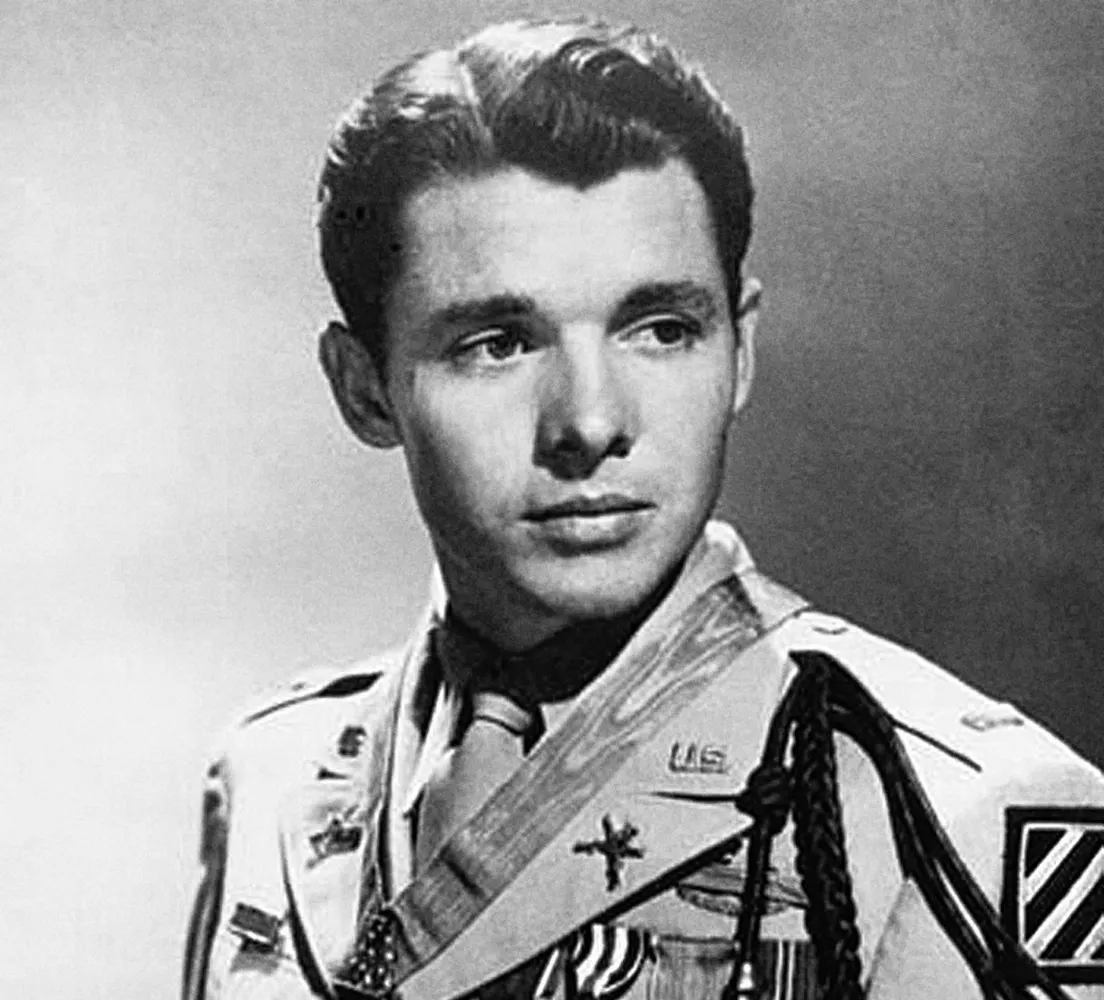
Audie Murphy was born on June 20, 1925, near Kingston, Texas, the seventh child and third son in a family that would eventually include twelve children. Life in Hunt County revolved around cotton fields, hard work, and making do with what was available.
Making do became a necessity.
His father, Emmett Murphy, worked as a sharecropper and drifted in and out of the family’s life before eventually leaving for good. His mother, Josie, carried the responsibility of raising the children largely on her own. Money was scarce, and every member of the family contributed when they could.
Years later, Murphy would joke about the size of the household.
“Every time my old man couldn’t feed the kids he had, he had himself another one.”
Behind the humor was a reality familiar to many families during the Great Depression: survival required everyone to pull their weight.
One of the ways young Audie helped was by hunting.
One shell. One shot.
The woods around Hunt County became an early classroom.
“He got a little ol’ .22—I don’t know where—but he was really good at it,” recalled his sister, Nadine Murphy, in a recent documentary. “He could kill a rabbit on the run. That’s how we lived. That’s how we ate. He would go out and kill squirrels, rabbits. I guess we could say we’re alive today because of him. He was my hero even then—before he did anything ‘great.’”
Ammunition cost money the Murphys rarely had. Sometimes, he only had one opportunity. Miss wasn’t simply disappointing—it could mean an empty table. Over time, Murphy learned to shoot quickly, accurately, and with purpose.
But perhaps more important than marksmanship was the responsibility that came with it. Long before anyone looked to him for leadership, younger siblings were already depending on him.
Growing Up Fast
The family eventually moved to Celeste, Texas, where Murphy’s father sought work through the Works Progress Administration. Even so, conditions improved only slightly. The house had electricity and a roof overhead, but little else.
Murphy entered first grade at age nine, nearly two years older than many of his classmates—and his formal education would not last long. When Murphy was in fifth grade, his father left for good, and the family’s financial situation worsened. He left school to work full-time and help support the household with whatever jobs he could find.
“He was very energetic,” childhood friend Monroe Hackney later recalled. “I mean, he worked real hard. Picked cotton, pulled corn, you name it. He did whatever needed to be done.”
Then came another loss. His mother—by all accounts the person he loved most—died in 1941, just days before her fiftieth birthday.
“When she died, the first thing I remember is wanting to do something for her,” recalled Murphy. “I still feel guilty that I never could.”
Years later, reflecting on his childhood, Murphy suggested that many of the qualities people would later admire in wartime had been forged long before he put on a uniform.
“I must have done some of my best fighting in a war I was in long before I joined the Army. You might say there never was a ‘peace time’ in my life, a time when things were good…. It was a full-time job just existing.”
Looking beyond Hunt County, Texas
Like many young men of his generation, Murphy grew up hearing stories of military service. Two of his uncles had served overseas during World War I, and while working in the cotton fields, they shared stories with him about the conflict and the people they had known.
The small Texas towns that had shaped him would always remain part of who he was. But by the time the United States entered World War II, the seventeen-year-old was looking beyond Hunt County for a way to serve—and a way to do something for his mother.
There was just one problem.
The military didn’t think he was big enough.
Too Small. Too Young. Too Determined.
By the time the United States entered World War II, Audie Murphy had already spent years carrying responsibilities that many adults would have struggled to shoulder.
He had left school to help support his family. He had worked fields, hunted game, and taken whatever jobs he could find. After his mother’s death, the future of his younger siblings weighed heavily on his mind.
When news of the December 1941 attack on Pearl Harbor reached Texas, Murphy began looking for a way into the military. The problem was obvious the moment he stepped into a recruiting office. He stood just 5 feet 5 inches tall and weighed roughly 110 pounds. Combined with his youthful appearance, he looked far younger than his actual age of 16.
The Marines turned him away. Army paratroopers did, too.
After years of helping support his family, he wasn’t accustomed to being told he couldn’t contribute.
“I want to succeed in the thing I started out to do. I hate failure. I hate quitters.”
Eventually, with help from his sister Corrine, Murphy successfully enlisted in the U.S. Army on June 30, 1942.
After months of rejection, he was finally in.
“You Can’t Let Your Comrades Down”
Murphy arrived in North Africa in 1943 as part of the 3rd Infantry Division and quickly gained a reputation as an aggressive and capable soldier. Promotions followed. So did combat.
The skinny teenager recruiters had doubted became one of the Army’s most reliable fighting men. Yet Murphy consistently pushed back against the idea that courage meant the absence of fear.
“I was scared before every battle. That old instinct of self-preservation is a pretty basic thing, but while the action was going on, some part of my mind shut off, and my training and discipline took over. I did what I had to do.”
Years later, when asked about courage in combat, he pointed not to patriotism or personal glory, but to the people fighting beside him. “Loyalty to your comrades, when you come right down to it, has more to do with bravery in battle than even patriotism does,” said Murphy. “You may want to be brave, but your spirit can desert you when things really get rough. Only you find you can’t let your comrades down, and, in the pinch, they can’t let you down either.”
That sense of responsibility would define the day he earned the Medal of Honor.
The Boy from Hunt County on a Burning Tank
After nearly three years in combat, Audie Murphy had been wounded multiple times, promoted through the ranks, and earned numerous decorations for valor.
Then came January 26, 1945.
Near Holtzwihr, France, Murphy’s company came under attack by a much larger German force supported by tanks. Outnumbered and under intense fire, he ordered his men to withdraw to prepared positions while he remained behind to direct artillery fire.
What happened next is best described in his Medal of Honor citation:
With the enemy tanks abreast of his position, 2d Lt. Murphy climbed on the burning tank destroyer, which was in danger of blowing up at any moment, and employed its .50-caliber machine gun against the enemy. He was alone and exposed to German fire from three sides, but his deadly fire killed dozens of Germans and caused their infantry attack to waver. The enemy tanks, losing infantry support, began to fall back.
For an hour, the Germans tried every available weapon to eliminate 2d Lt. Murphy, but he continued to hold his position and wiped out a squad which was trying to creep up unnoticed on his right flank. Germans reached as close as 10 yards, only to be mowed down by his fire. He received a leg wound, but ignored it and continued the single-handed fight until his ammunition was exhausted. He then made his way to his company, refused medical attention, and organized the company in a counterattack, which forced the Germans to withdraw. His directing of artillery fire wiped out many of the enemy; he killed or wounded about 50. Second Lt. Murphy's indomitable courage and his refusal to give an inch of ground saved his company from possible encirclement and destruction, and enabled it to hold the woods which had been the enemy's objective.
Viewed through the lens of Murphy’s life, the action reveals a familiar pattern. Long before soldiers depended on him in France, family members had depended on him in Texas.
The circumstances had changed. The sense of responsibility had not.
By the end of World War II, Murphy had received every US Army combat award for valor available during his service, along with decorations from France and Belgium. The Medal of Honor would eventually make him a household name.
But Murphy never seemed entirely comfortable with the title that followed him for the rest of his life:
“I never liked being called the ‘most decorated’ soldier. There were so many guys who should have gotten medals and never did—guys who were killed.”
Returning home
For nearly three years, Murphy had lived the life of a soldier. The future was measured from minute to minute in missions, movements, and survival.
When Germany surrendered in May 1945, that changed. Years later, Murphy recalled what he first felt when he heard the news.
“I started to think about home for a change, which we didn’t dare think of before, because, as you know, you live from day to day, minute to minute in most cases. And suddenly I was a little frightened.
“Strange as it might seem, I didn’t know what I’d do when I got home, and I suddenly felt just a little empty inside, a little lonely about the whole thing. Although I was very happy the war was over, I suddenly didn’t feel that I had a home.”
For a young man who had spent much of his life searching for stability and purpose, the transition back to civilian life would present a new set of challenges.
"I have to admit I love the damned Army. It was father, mother, brother to me for years,” he mentioned later. “It made me somebody, gave me self-respect."
Yet, like the responsibilities that had shaped his childhood and military service, Murphy continued moving forward.
From the Homefront to Hollywood
The uncertainty Murphy felt at war’s end did not disappear overnight. But over time, he built a legacy that reached far beyond the battlefield.
He wrote the bestselling memoir To Hell and Back, sharing his experiences with a generation seeking to understand the war. The book was later adapted into a film in which Murphy portrayed himself, helping preserve the stories of the soldiers with whom he served.
Hollywood became an unlikely second act. Murphy appeared in more than 40 films, becoming one of the era’s most recognizable western stars. He also pursued another lifelong interest: writing. In addition to publishing poetry, he co-wrote 17 country-western songs, several of which were recorded by prominent artists, such as Shutters and Boards.
Yet Murphy’s most enduring contribution may have been the way he used the visibility that came with the Medal of Honor. At a time when many veterans suffered in silence, he spoke openly about the challenges of returning home from war and advocated for greater understanding and support for those who had served.
"People are very quick to ridicule others for showing fear,” said Murphy. But we rarely know the secret springboards behind human action. The man who shows great fear today may be tomorrow's hero. Who are we to judge?"
Audie Murphy’s story is often remembered through a burning tank destroyer in France. Yet long before that day—and long after it—he was guided by the same qualities that first emerged in the cotton fields of Texas: responsibility, determination, and a commitment to others.
The boy from Hunt County never entirely disappeared. He simply carried those lessons with him.
THEIR STORIES. OUR HISTORY.
Long before Audie Murphy became one of the most decorated American soldiers of World War II, he was a Texas farm boy helping his family survive the Great Depression. His story reminds us that extraordinary acts often begin with ordinary responsibilities—and the decision to keep showing up when others depend on you.
As America approaches its 250th anniversary, stories like these remain part of the living character of our nation. Thank you for helping us carry them forward.