A Promise Made at 18: Tibor Rubin’s New Beginning
Before the Medal of Honor, Tibor Rubin was an 18-year-old starting over in a new country, with little to his name but broken English and a promise to keep.
Most of us think a fresh start is a choice—something we decide when the timing feels right, when the calendar turns, or when we’re ready for a change.
For Tibor Rubin, starting over was the next step after survival.
After World War II, Rubin was among many displaced people trying to rebuild their lives in Europe. He had survived imprisonment in a concentration camp, and he was liberated by American soldiers—an experience that not only saved his life, but also profoundly shaped it.
What follows are the lesser-known parts of Tibor Rubin’s story: before he made a life in the United States, before the choices he made during the Korean War, and how he proved—again and again—what it means to keep a promise.
“When am I going to be next?”
Tibor Rubin was born in Hungary, in a small town called Pásztó. In his memory, the beginning of his life is simple: a family, a home, a sense of peace. “I had a beautiful family. We lived peacefully. We had a beautiful life there. We didn’t bother anybody, and nobody bothered us, really.”
Then, as anti-Semitism spread across Europe, everything changed.
Rubin was 13 years old when he was separated from his family and forced into a concentration camp. There was no expectation of getting out alive. “It was a terrible life,” Rubin said in a 2021 video. “Nothing to look forward to—just, ‘When am I going to be next?’”
Rubin was freed when American soldiers broke through the gates of the camp. He remembered the moment as unforgettable. Afterward, he carried a deep, driving gratitude—one marked not just by survival, but by a commitment to serve.
“So I made a promise. If—Lord help me—if I ever go to America, I’m gonna become a G.I. Joe.”
For young displaced people in the late 1940s, immigration was rarely a clean break or a hopeful leap—it was a necessity shaped by loss, logistics, and opportunity. When Rubin immigrated to the United States to join his family in 1948, his first years were defined less by certainty than by determination. He struggled with the language and tried to enlist in the Army, failing the English test in 1949 before making it in on a second try in 1950.
“At some point, we’ve all been 18 and struggling to figure out what to do with our lives,” said Kali Schick, Senior Historian at the National Medal of Honor Museum. “I like to think that question—’When am I going to be next?’—is what pushed him toward what he could be and do, all inspired by a promise he fully intended to keep.”
Keeping a Promise, Even When It Gets Hard
Enlisting in the U.S. Army in 1950 was one way to keep his promise. Living it out, day after day, was another.
In his own telling, Rubin learned quickly that the uniform did not erase prejudice. “Every time he needed a volunteer… he always called for me,” Rubin recalled. “‘Get me that [censored] Hungarian Jew.’”
In one situation, Rubin was ordered to remain behind as a rear guard while his unit withdrew to a new defensive position, and he was to hold that ground until they returned for him. He prepared by moving weapons and supplies from foxhole to foxhole to make it look like more than one man was defending the position. When enemy troops advanced, he held the hill long enough for his unit to retreat safely.
“For twenty-four hours I was up there,” Rubin said. “I prayed to Jesus, Mohammed, Moses, Buddha. I said, ‘Somebody get [me] outta here. This place is too tough—too rough!’”
He held the position through the night—and then waited. When no relief came, Rubin remained on his own for days. Eventually, when it became clear no one was coming back for him, he left the hill and made his way back to friendly lines.
Later in the war, Rubin was wounded and captured, spending months in a POW camp where hunger, illness, and exposure made survival uncertain. He repeatedly slipped out to steal food from enemy storehouses and gardens, then brought it back to share with starving prisoners. He helped sustain morale among men who were exhausted and afraid. He also provided medical care and moral support, healing one prisoner with goat pellets, the power of suggestion, and hope—because that was all they had (get the full story here).
In the POW camp, Rubin described doing whatever he could to keep others alive—finding food, improvising care, and stepping into whatever role was needed. “I was there when they needed me,” Rubin said. “I’d feed them… handyman… doctor… nurse… friend.”
Even when he was offered the chance to leave the camp and return to Hungary, Rubin stayed with his fellow American prisoners. His actions in captivity were later credited with saving more than forty lives.
“What makes Tibor Rubin’s life and story so compelling is how he operates with such integrity,” adds Schick. “We’ve all made promises to ourselves—and we tend to break those promises more easily than those we make to others, with far less pressure than what Tibor Rubin experienced. He was challenged repeatedly. He was literally offered a ‘Get out of jail free’ card. Yet he honored his commitment to serve, over and over again.”
Bringing Integrity to Life: A Promise Comes Home
When recounting those moments, he resisted the language of heroism. “I didn’t want to become a hero,” he said later. “Because to become a hero is not an easy thing.”
After the war, Rubin returned to civilian life. He married, raised a family, and worked— building a home and a future. Like many veterans, he did not spend those years publicly revisiting what he had done or endured. The recognition that would later shape his public identity had not yet arrived, and for decades, much of his story lived in the accounts of the men who served beside him.
The Medal of Honor did not come until 2005—more than fifty years after Rubin was recommended for it multiple times by his fellow soldiers. When it finally did, it was presented by President George W. Bush during a White House ceremony, with Rubin’s family in attendance, including his wife, Yvonne, and daughter, Rosie. Rubin spoke candidly about the weight of that delay. “I waited 55 years,” he said. “Yesterday I was just a schmuck—today they call me ‘sir.’”
Schick is careful to describe what that moment represents—and what it does not. “As a historian, you look at the full record and see that the Medal doesn’t create identity,” she explains. “In Rubin’s case, it names something that was already visible in his actions—across decades, in war and beyond it.”
The Enduring Commitment
Decades earlier, he had arrived in the United States as a displaced young man. He learned a new language, found work, and kept moving toward the promise he made after liberation. Over time, that promise became more than becoming a “GI Joe.” It became a life in America—service in uniform, a family and work afterward, and eventually citizenship. And when he stood in the White House in 2005, he put it simply: “It is the best country in the world. And I’m part of it now.”
Rubin’s service did not end with the story people have come to know. Throughout his post-military life, he regularly volunteered at the Long Beach VA, quietly logging more than 20,000 hours in support of other veterans. He also stayed connected with comrades around the world, traveling to visit former POW friends and remaining close to the community shaped by those shared years.
In 2017, two years after his death, the Long Beach VA Medical Center was renamed in his honor—a gesture that formally acknowledged his wartime courage and the steady generosity and support he gave fellow service members throughout his life.
Stay Informed with the Latest News
From groundbreaking announcements to exclusive stories, explore more updates from the National Medal of Honor Museum. Browse our latest press releases and articles to stay connected with our mission and milestones.
NMOHMF Thanks Senate National Parks Subcommittee
May 14, 2024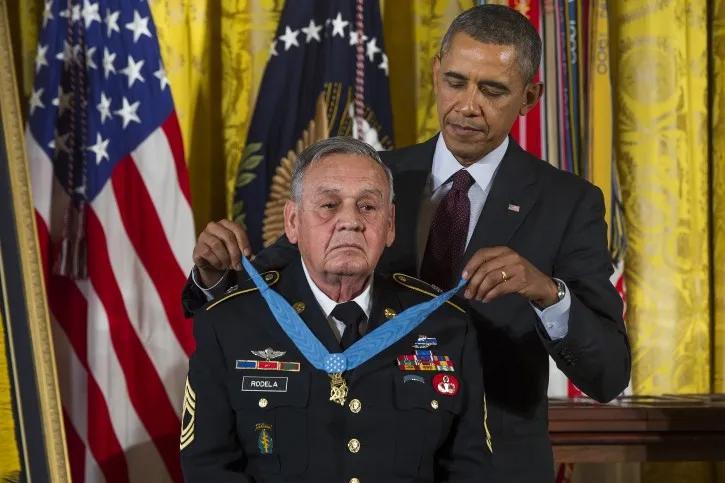
An elite special forces leader: Meet Army MOH Recipient Jose Rodela
Aug 18, 2025
Into the Fire. Out of the Cave. : Meet Army MOH Recipient Gary Beikirch
Aug 18, 2025
Honor in Nature: The Outdoor Experience at the National Medal of Honor Museum
Jun 18, 2025FREQUENTLY ASKED QUESTIONS
Tibor Rubin (June 18, 1929–December 5, 2015) was a Hungarian-born Holocaust survivor who immigrated to the United States as a displaced young man and later enlisted in the U.S. Army. He served in the Korean War, endured captivity as a POW, and eventually received the Medal of Honor in 2005 for actions recognized across his combat services and imprisonment.
Read Tibor Rubin’s Medal of Honor Citation here.
World War II uprooted tens of millions of people. When it ended, about 11 million were classified as “displaced persons”—people who could not safely return home because their community had been destroyed, borders had shifted, or the risks of returning were too high. Many survivors lived for months or years in displaced person (DP) camps and resettlement centers while they searched for family, waited on paperwork, and pursued immigration options.
Rubin was recommended for the Medal of Honor by fellow soldiers, but the award was not presented until 2005—more than five decades after the actions it recognizes. Multiple historical accounts describe discrimination within his chain of command as a factor in the delay of his recognition; the Medal was ultimately approved and presented by President George W. Bush at the White House.
Rubin’s delayed recognition is one example of how formal reviews of records and testimony can bring renewed attention to earlier recommendations that didn’t result in an award at the time.
Learn more about delayed awards in the Triumph & Valor exhibit at the National Medal of Honor Museum. Plan your visit today.
You can begin online with Tibor Rubin’s Recipient page and Medal of Honor citation—then experience the fuller story in person at the National Medal of Honor Museum, where you can hear him tell his story in his own words alongside curated content, interviews, and artifacts.
Plan your visit to the National Medal of Honor Museum here.